
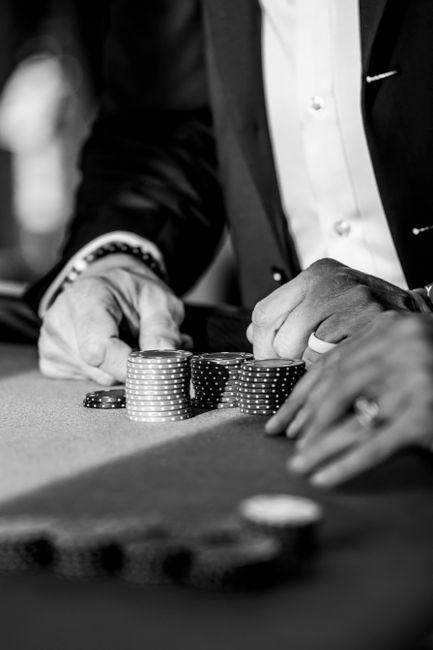
Every seasoned player eventually confronts the same uncomfortable question: how much of this is actually up to me? Walk into any poker room and you'll hear someone blame a bad beat for a lost session. Walk into a slots hall ten minutes later and you'll watch a guy feeding a machine like it owes him money, convinced the next spin is the one. Both players are telling themselves a story about control. Only one of them is mostly right.
Understanding where skill ends and randomness begins isn't just an academic exercise. It changes which games you play, how you size your bets, and whether you walk away at midnight or at 4 a.m. Let's break down the actual mechanics.
The Skill-to-Luck Spectrum
Games don't fall into neat "skill" or "luck" buckets. They sit on a spectrum, and the position on that spectrum determines everything about your long-term expectations.
- Pure chance: Slots, roulette, keno, baccarat (betting side, not dealing). No decision you make meaningfully changes the house edge beyond picking which bet to place.
- Small edge for skill: Blackjack with basic strategy cuts the house edge to roughly 0.5 percent. Card counting can flip it into positive territory, but only with disciplined play and tolerance from the casino.
- Meaningful skill: Video poker with optimal strategy, sports betting against the closing line, and live poker. A strong poker player can be profitable over thousands of hands.
- Dominantly skill: High-stakes heads-up poker, daily fantasy, arbitrage betting. Here, luck is noise around a genuine signal.
The key insight: the length of your session determines whether luck or skill dominates your results. In a single hand of Texas Hold'em, a beginner can beat a pro. Over 100,000 hands, that nearly never happens.
Why Slots Feel Skillful (They Aren't)
Modern slot machines are engineered to make you feel agency where none exists. The stop button, the "skill stop" timing, the near-misses that land one symbol off the jackpot line — all of it is theater.
Every spin is an independent event governed by a random number generator (RNG). The machine has no memory. A slot that hasn't paid out in three hours is no more likely to hit than one that just paid. This is the gambler's fallacy, and it's the single most expensive misconception in the casino.
What you can control:
- The game's RTP (return to player) — usually 92 to 97 percent on land-based machines, higher on some online variants
- Volatility — high-volatility slots pay rarely but big; low-volatility slots pay often but small
- Your bet size relative to your bankroll
- When you stop
On a 94 percent RTP machine, you're expected to lose four cents per dollar wagered, forever, on average. No strategy changes that number. You can only change how long you play and how much you expose.
Where Skill Genuinely Moves the Number
Poker is the cleanest example. A player who understands position, pot odds, and range construction has a measurable edge over someone who plays their cards face-value. That edge shows up in win rate, usually expressed in big blinds per 100 hands (bb/100). A winning low-stakes player might post 3 to 8 bb/100. A great one at high stakes might manage 2 to 4 bb/100 against tougher fields — because as opponents get better, your edge compresses.
Sports betting works differently. The closing line is essentially the market's best estimate of true probability. Beating it consistently by more than 2 to 3 percent over hundreds of bets is a genuine skill signal; beating it over a weekend is variance.
Blackjack sits in the middle. Basic strategy is mechanical and learnable in a weekend. Deviating from it — even "intuitively" — costs you roughly 2 percent of your expected return. That's a real, quantifiable skill component most players ignore. For a closer look, đánh đề online has helpful details.
Bankroll Management: The Skill Nobody Talks About
If there's one skill that separates survivors from casualties, it's bankroll discipline. Not card sense, not pattern recognition — math about survival.
A few concrete rules that hold up:
- Poker: Keep at least 20 buy-ins for cash games and 50 to 100 for tournaments. Less than that and one bad run wipes you out regardless of how well you play.
- Sports betting: Flat-bet 1 to 2 percent of your bankroll per wager. No chasing, no "lock of the year" doubling.
- Slots and table games: Treat the entire session stake as already spent entertainment money. If losing it would hurt, you've bet too much.
The math here isn't glamorous, but it's the reason some people are still playing after five years and others quit broke in five weeks.
The House Edge Is Not Negotiable, But Your Exposure Is
Every casino game has a built-in advantage for the house. That's the business model, not a bug. Here's a rough comparison of edges on common bets:
- Blackjack (basic strategy): ~0.5%
- Baccarat (banker bet): ~1.06%
- Craps (pass line): ~1.41%
- European roulette: ~2.7%
- American roulette: ~5.26%
- Slots: 3% to 8% typically
- Keno: often 25% or worse
Over a thousand dollars wagered, the difference between American and European roulette is about $26. Over a hundred thousand, it's $2,600. Game selection is a skill, and ignoring it is expensive.
What This Means for How You Actually Play
If you want to win over time, gravitate toward games with a real skill edge — poker, selective sports betting, advantage play where legal. If you want entertainment with a controlled cost, pick low-edge games, set a loss limit, and stick to it. What doesn't work is playing a luck-dominant game while telling yourself your gut is a strategy.
The casino doesn't mind confident players. It minds disciplined ones. Be the second kind.


Zhon Andarson
Coding is used in almost all aspects of life and work now, be it directly or indirectly. It’s not just for companies in the tech sector. “An increasing number of businesses rely on computer code,
Andro Smith Doe
Coding is used in almost all aspects of life and work now, be it directly or indirectly. It’s not just for companies in the tech sector. “An increasing number of businesses rely on computer code,